
Phillips County District Court Overview
District Court is the general-jurisdiction trial court for Phillips County. It operates locally through Phillips Combined Court in Holyoke, where district-court and county-court functions share the same courthouse address. District Court handles felonies, larger civil disputes, domestic-relations cases such as divorce and custody, juvenile matters, probate, and county-court appeals. It is the court to check for felony criminal files, divorce decrees, parenting plans, estate cases, protection-order files connected to district matters, and civil judgments outside the county-court lane.
Phillips County is in Colorado's 13th Judicial District with Kit Carson, Logan, Morgan, Sedgwick, Washington, and Yuma Counties. That regional structure explains why several judges listed for Phillips County also serve other counties. A Phillips docket may show a judge or court staff member whose primary phone number is in another 13th Judicial District courthouse. The official local court contact remains Phillips Combined Court at 221 S. Interocean Avenue, 2nd Floor, Holyoke, CO 80734, phone 970-762-7010, email PhillipsClerksOffice@judicial.state.co.us.
The courthouse itself is part of the county records story. The History Colorado Phillips County Courthouse page identifies the building as a New Deal-era courthouse designed by Eugene G. Groves and listed in the National Register of Historic Places.
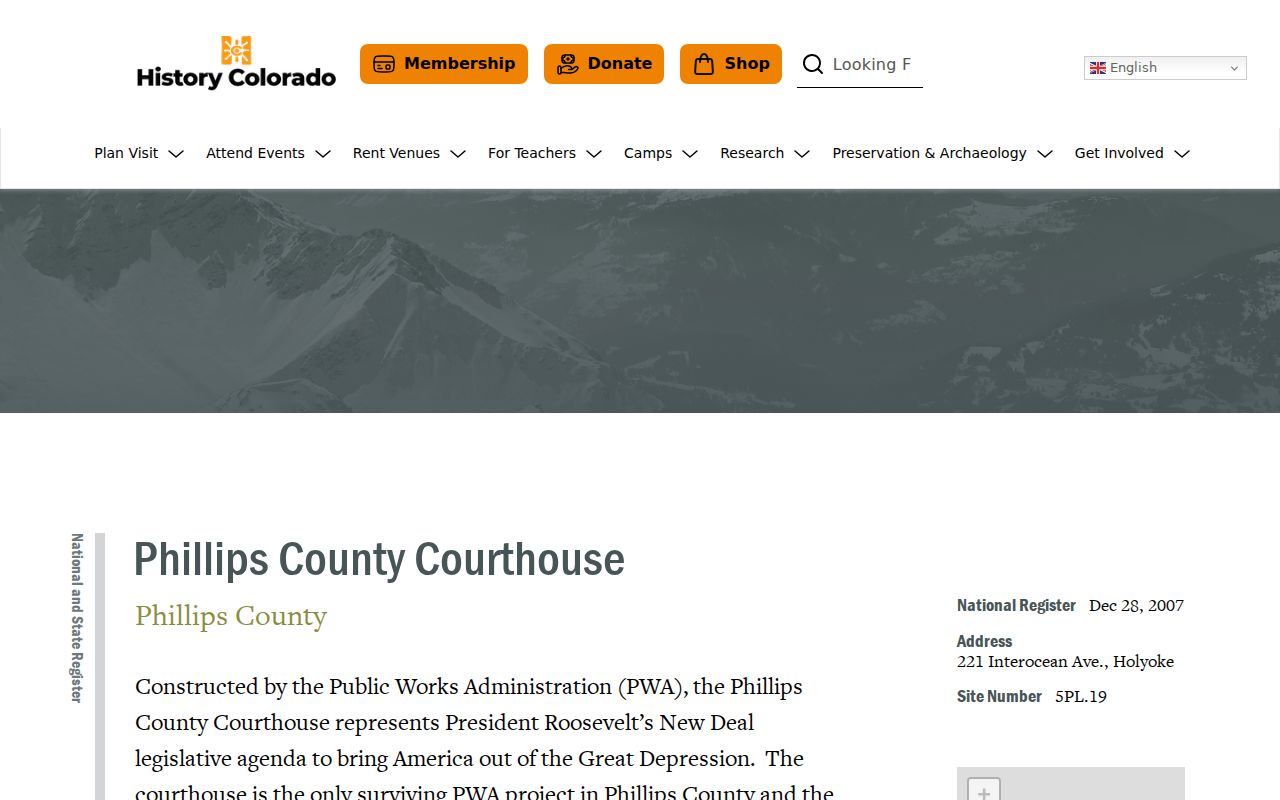
The same courthouse remains the working local court location, so district-court users are dealing with both an active judicial office and a historic county-government building.
List of Phillips County District Courts
Phillips County does not have several separate numbered district courthouses. District Court service is provided through Phillips Combined Court. The table below separates the local court functions and district-wide assignments so users can understand what to request and where to call. For ordinary Phillips County records, start with the local combined court rather than calling every judge's primary county.
| Court or office | Type | Address | Phone |
|---|---|---|---|
| District Court, 13th Judicial District | Felony, civil, domestic relations, juvenile, probate, appeals | 221 S. Interocean Avenue, 2nd Floor, Holyoke, CO 80734 | 970-762-7010 |
| County Court, Phillips County | Misdemeanors, traffic infractions, small claims, limited civil, protection orders, felony complaints | 221 S. Interocean Avenue, 2nd Floor, Holyoke, CO 80734 | 970-762-7010 |
| Clerk of Court | Court records, filings, dockets, copies, jury commissioner role | 221 S. Interocean Avenue, 2nd Floor, Holyoke, CO 80734 | 970-762-7010 |
| 13th Judicial District self-help | Self-represented litigant and family-court support | District-wide resource linked by Judicial Branch | 970-542-5252 |
Current Judicial Branch staff listings include Carl S. McGuire III as Chief Judge, District Court judges Matthew W. E. Bradley, Dina M. Christiansen, Stevie M.G. Gagliano, Robert C. James, and Kimbra L. Killin serving Phillips among other counties, and Kimberlee Keleher as Phillips County Court Judge, Division 4. Kathy Browning is listed as Jury Commissioner and Clerk of Court for Phillips and Sedgwick Counties.
District Court vs. County Court vs. Municipal Court
Colorado's trial-court map matters for Phillips County records because the same building may house different court levels. District Court is the general-jurisdiction court. County Court handles lower-level state matters, including traffic infractions and misdemeanors. Municipal Court is a lower local-court concept for ordinance matters, but no separate Holyoke municipal court portal was located in the official sources inspected for this project. If a ticket or summons came from a city or town authority, users should check the issuing document and contact that municipality directly.
| District Court | County Court | Municipal Court | |
|---|---|---|---|
| Civil Limit | General civil jurisdiction for larger matters | Civil cases under $25,000 and small claims | Ordinance or municipal matters where a local court exists |
| Criminal Jurisdiction | Felonies and serious criminal proceedings after filing or transfer | Misdemeanors, traffic cases, and felony complaints before district-court transfer | Municipal ordinance violations, if issued by a city or town court process |
| Family Cases | Divorce, custody, parenting plans, support, and related domestic relations | Not the primary domestic-relations court | No domestic-relations jurisdiction located in research |
| Probate | Probate Division of District Court | Not the local probate court | No probate role located |
How a Case Moves Through the Phillips County System
District-court and county-court paths can overlap. A felony may begin with a complaint or first appearance stage connected to county court, then move into District Court for prosecution. A misdemeanor or traffic infraction may stay in County Court. A civil dispute may be filed in County Court if it falls within the county-court amount limit, while larger civil matters and appeals move through District Court. Domestic-relations and probate matters start in District Court because those categories belong to district jurisdiction.
Criminal flow: Arrest or summons › first appearance › complaint or information › advisement or arraignment › pretrial hearings › plea or trial › disposition or sentence order › appeal where allowed.
Civil flow: Complaint or petition filed › service › answer or response › motions › disclosures or discovery › hearing, settlement, or trial › judgment › post-judgment filings or appeal.
Probate and domestic flow: Petition or application filed › notice and required forms › hearing or administrative review where needed › court order, decree, letters, or plan › later modification, enforcement, closing, or certified-copy request.
Civil, Family, and Criminal Divisions
District Court records in Phillips County can be requested by case type through the Judicial Branch form. Civil documents may include complaints, answers, motions, orders, judgments, transcripts of judgment, satisfactions of judgment, and protection-order filings. Family and domestic-relations records may include divorce decrees, parenting plans, separation agreements, support orders, and petitions. Criminal district records may include felony complaints or informations, bond orders, motions, plea paperwork, disposition or sentence orders, minute orders, and register-of-actions entries.
Users should distinguish a court case record from a statewide background check. The Colorado Bureau of Investigation Internet Criminal History Check is the official Colorado name-based criminal-history search, while the district court file shows what happened in a particular case. Similarly, a divorce decree is a District Court record, while a marriage license is handled by the Phillips County Clerk and Recorder. Probate records are filed in the District Court probate division, but recorded deeds or property transfers flowing from an estate may appear in the recorder's records.
Judicial Circuit / District
Phillips County is part of the 13th Judicial District. The district covers a large rural region of northeastern Colorado and includes Logan, Kit Carson, Morgan, Phillips, Sedgwick, Washington, and Yuma Counties. The 13th Judicial District Attorney's Office describes its jurisdiction as covering 11,432 square miles and serving about 80,832 people, with the Sterling Office serving Phillips County for district attorney contact. That regional structure affects court calendars, judge assignments, public defender service, and self-help resources.
The current court roster lists Carl S. McGuire III as District Court Chief Judge for the 13th Judicial District. Other district judges serving Phillips County include Matthew W. E. Bradley, Dina M. Christiansen, Stevie M.G. Gagliano, Robert C. James, and Kimbra L. Killin. The Colorado State Public Defender Sterling Office serves Phillips County along with the other 13th Judicial District counties. Self-represented litigants may see district-wide resources such as 13SelfHelp@judicial.state.co.us and Family Court Facilitator Dawn Gerk listed on Judicial Branch pages.
Magistrate and Lower Courts
The lower-court layer for Phillips County is County Court, not a justice-of-the-peace court. County Court handles misdemeanors, traffic infractions, small claims, civil cases under the county-court limit, protection orders, and felony complaints that may later be sent to District Court. County-court decisions may be appealed to District Court. Municipal ordinance cases, if any, should be checked through the issuing municipality because the official research did not locate a separate Phillips County municipal court portal.
Record access should follow the court level where the case sits. For a traffic ticket, search the Judicial Branch docket page, use CoCourts if the county traffic case is covered, request a ticket copy through the record/document form, or pay eligible obligations through the Colorado Judicial Online Payment System. For a felony, divorce, probate matter, or larger civil case, use District Court records channels. For county recorded documents, use the Phillips County Clerk and Recorder instead of the Clerk of Court.
Appeals also follow the level of court. County-court decisions may be appealed to District Court. District-court appeals generally move to the Colorado Court of Appeals, with further review by the Colorado Supreme Court where allowed. Federal criminal charges, federal civil claims, bankruptcy cases, and Tenth Circuit appeals are outside the Phillips County District Court structure, even if the people or events are connected to Phillips County. Those records use federal court systems such as PACER and the federal District of Colorado or Bankruptcy Court.
Because Phillips County is rural and court appearances are in person unless a court order says otherwise, users should confirm the hearing location and counter hours before traveling. Official sources did not identify a public courthouse shuttle, paid garage, or separate juror lot. Plan around the courthouse address on South Interocean Avenue, allow time for parking and building entry, and call 970-762-7010 before a trip if the question involves an older file, a restricted case, or a certified copy deadline.